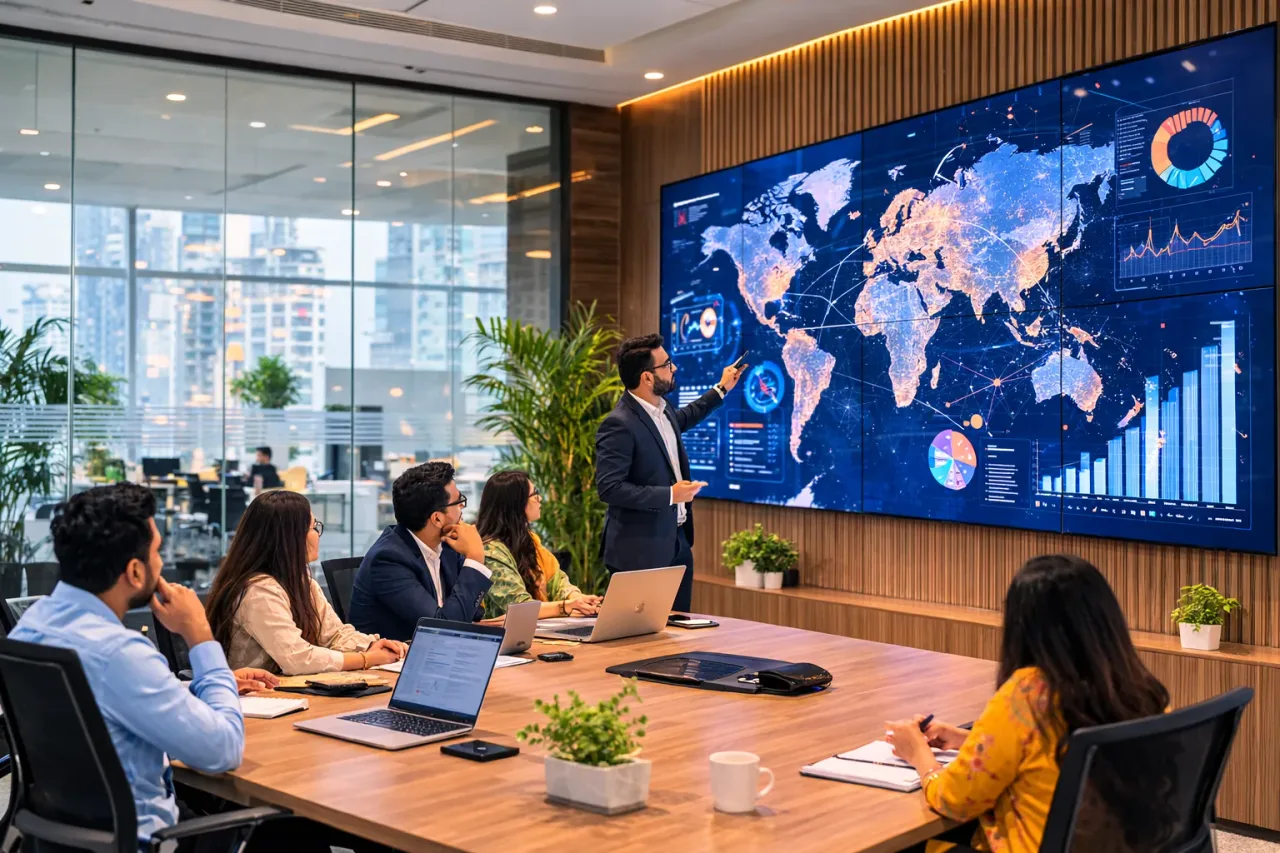
Quick Summary
- Improves communication quality in meeting and briefing rooms.
- LED: seamless modular design and high visual impact.
- Short viewing distance generally needs finer pitch.
Introduction
Practical corporate guide for selecting LED video wall for office spaces, conference rooms, and executive communication environments. The sections below explain the practical choices, trade-offs, and planning details to review before selecting a solution or requesting a quotation.
For available models and current planning details, visit our .
Table of Contents
Section 1
Why Offices Use LED Video Walls
Modern offices use LED video walls to improve communication clarity in boardrooms, presentation halls, and reception areas. Compared to basic displays, LED walls provide stronger visual impact and better readability for larger audiences.
For executive meetings and hybrid collaboration, clear content delivery is essential. LED video walls can support dashboards, presentation content, and live video feeds in one unified large format.
Corporate teams also use LED walls to strengthen brand perception in client-facing spaces where first visual impression matters.
- Improves communication quality in meeting and briefing rooms.
- Supports larger visual canvas for data, charts, and multimedia.
- Creates premium look in reception and executive spaces.
Section 2
LED Video Wall vs LCD Video Wall
LED video walls provide near-seamless large-format viewing, while LCD video walls are panel-based and usually show bezel lines between screens.
For close-view control rooms, LCD can still be useful in some scenarios. But for larger corporate spaces where seamless output and scale flexibility are required, LED is often preferred.
Decision should be based on audience distance, room lighting, desired visual continuity, and long-term usage goals.
- LED: seamless modular design and high visual impact.
- LCD: panel-based wall with visible bezels in multi-screen setup.
- LED is often stronger for premium boardroom and lobby applications.
Section 3
Ideal Pixel Pitch for Offices
Pixel pitch selection is critical for office environments because meeting participants often view content from short to medium distance.
Finer pitch provides better text and chart readability, which is important for presentations, analytics dashboards, and video conferencing.
The ideal pitch depends on room size, seat layout, and the smallest text you need to display clearly.
- Short viewing distance generally needs finer pitch.
- Presentation-heavy use cases require strong text clarity.
- Pitch should be selected after measuring actual seat-to-screen distance.
Section 4
Installation Requirements
Corporate LED installation requires proper wall/structure support, stable power supply, and safe cable routing. These requirements should be validated before procurement.
Ventilation, front or rear service access, and signal routing must be planned so maintenance can be done without business disruption.
For conference rooms, acoustic consideration and camera framing (for video meetings) should also be reviewed during installation design.
- Confirm structural readiness and maintenance access path.
- Ensure stable power, grounding, and signal routing quality.
- Plan installation workflow to minimize office downtime.
Section 5
Cost Considerations
Corporate LED video wall cost depends on pixel pitch, screen size, controller ecosystem, installation complexity, and support scope.
Instead of comparing price only, evaluate lifecycle value: visual performance, reliability, maintenance ease, and future expansion capability.
A BOQ-based quotation with clear scope helps avoid hidden cost and ensures better purchasing decisions.
- Compare both upfront cost and long-term operating value.
- Check support scope: installation, calibration, and after-sales coverage.
- Use site-based specification to avoid overbuying or underbuying.