Quick Summary
- Never finalize pitch without distance and content mapping.
- Apply electrical QA checklist before first power-on.
- Even well-installed screens degrade when teams lack SOP. Untrained operators, unmanaged content pipeline, and delayed maintenance quickly reduce confidence.
Introduction
The most expensive LED mistakes in planning, procurement, installation, and operations, plus the prevention checklist we use. The sections below explain the practical choices, trade-offs, and planning details to review before selecting a solution or requesting a quotation.
For available models and current planning details, visit our . For topic-specific options, see our .
Table of Contents
Section 1
Planning and Procurement Mistakes
Selecting pitch by price only, ignoring content type, and skipping site risk checks are the top pre-install mistakes. These issues usually appear later as readability complaints or unstable operations.
A small planning shortcut often creates large downstream cost.
- Never finalize pitch without distance and content mapping.
- Do not mix incompatible accessories to reduce upfront cost.
- Include spare and maintenance plan inside initial BOQ.
Section 2
Installation and Commissioning Mistakes
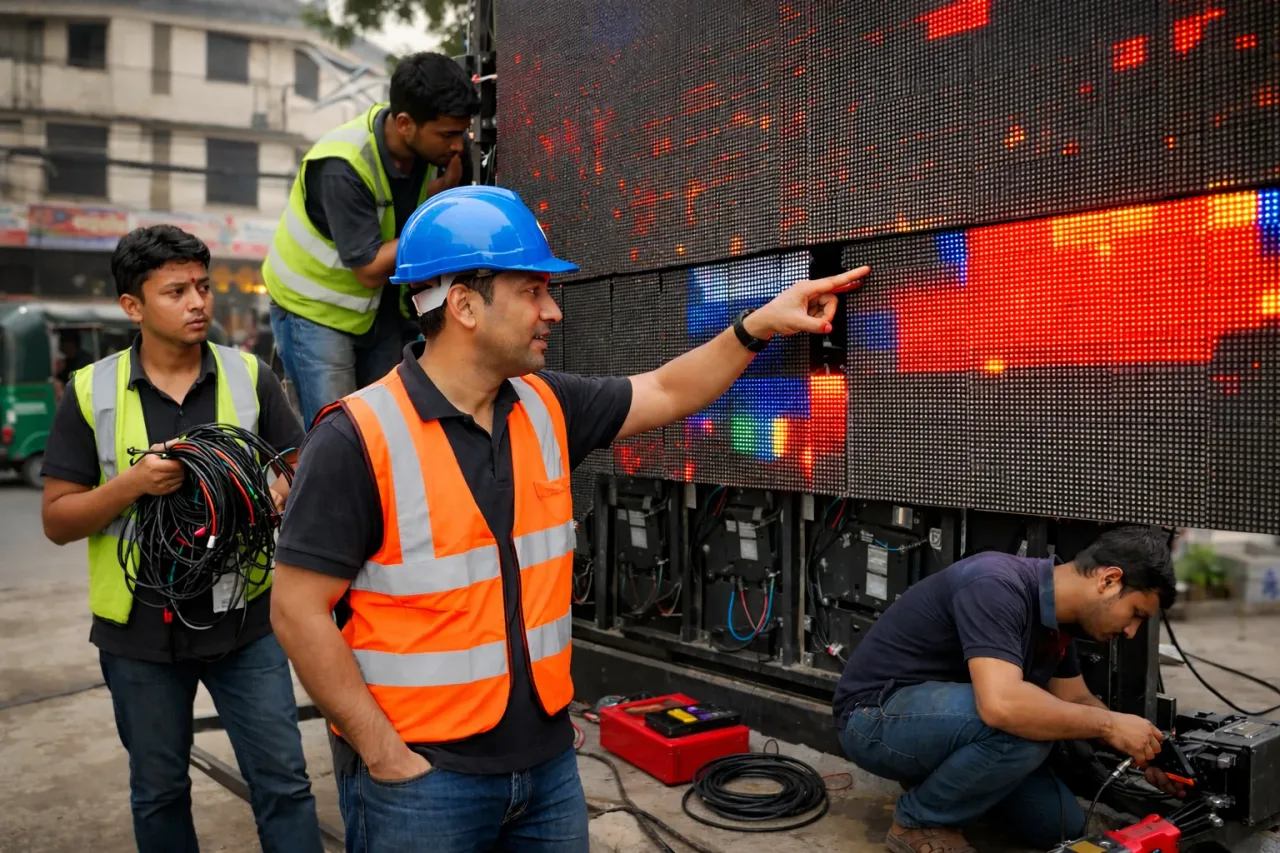
Rushed wiring, poor grounding discipline, and incomplete mapping validation can create intermittent faults that are hard to diagnose. Commissioning should not be compressed to meet arbitrary deadlines.
Quality acceptance must include real content testing, not only pattern testing.
- Apply electrical QA checklist before first power-on.
- Run mapping verification under production-like content loads.
- Save rollback profiles to recover quickly from misconfiguration.
Section 3
Post-Handover Operation Mistakes
Even well-installed screens degrade when teams lack SOP. Untrained operators, unmanaged content pipeline, and delayed maintenance quickly reduce confidence.
Assign clear ownership for daily checks and escalation path.
Section 4
Our Delivery Framework: From Survey to Handover
Every project follows a fixed delivery framework so quality does not depend on luck: requirement discovery, site survey, technical recommendation, BOQ, electrical plan, structure review, installation, calibration, and handover.
This process reduces rework because decisions are validated before hardware reaches site.
- Pre-sales survey with viewing distance, daylight exposure, and content format checks.
- Controller-power-module compatibility check before procurement finalization.
- On-site quality checklist: grounding, mapping, thermal behavior, calibration.
- Handover package: wiring map, controller profile backup, and operator SOP.
Section 5
Bangladesh Deployment Realities We Plan For
Bangladesh projects need local context planning: high humidity, dust exposure, power fluctuation, monsoon rain, and heavy runtime during campaign periods.
We design maintenance and backup strategy early so the screen remains stable after launch.
- Division and district-level logistics coordination for installation windows.
- Power protection planning for unstable line conditions.
- Remote troubleshooting workflow for faster issue isolation.
Section 6
Accessory Stack We Commonly Standardize
Long-term uptime depends on stack quality, not only display module quality. Controller, receiving card, PSU, and signal chain must be matched as one system.
We align ecosystem choices with project complexity and operator capability.
- Controllers: Huidu, Colorlight, Novastar based on workflow depth and scaling plans.
- Power layer: G-energy class PSU and equivalent stable options where applicable.
- Module-accessory matching: Lampro and compatible professional-grade classes.