Quick Summary
- Real lifespan depends on maintenance quality and operating discipline.
- Ambient heat and airflow quality.
- Perform regular surface and ventilation cleaning.
Introduction
Practical guide to LED display lifespan, maintenance routine, common failure points, and proven ways to extend screen life. The sections below explain the practical choices, trade-offs, and planning details to review before selecting a solution or requesting a quotation.
For available models and current planning details, visit our . For topic-specific options, see our .
Table of Contents
Section 1
Average Lifespan
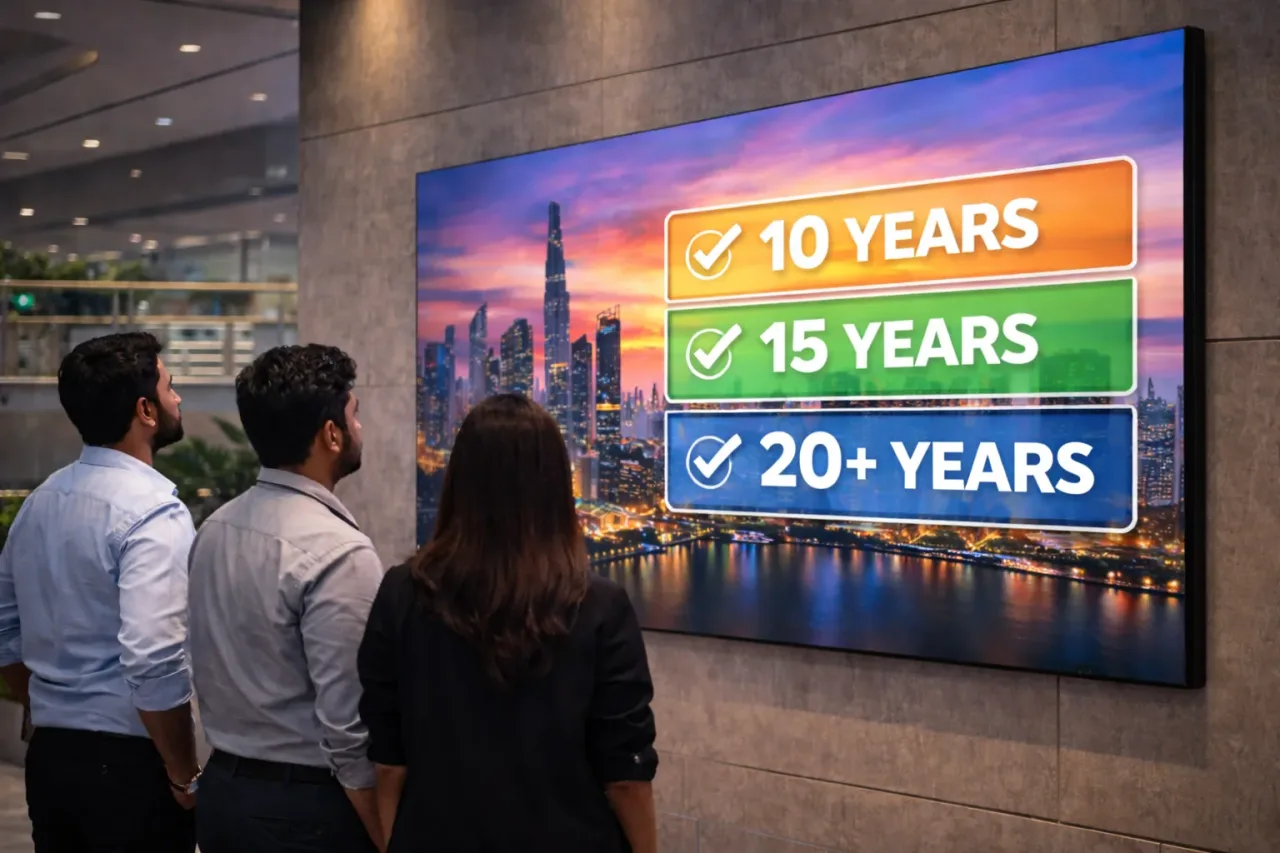
A quality LED display can typically run for many years when operated under proper conditions. In practical business use, panel life is usually influenced by brightness usage pattern, runtime hours, temperature, and maintenance frequency.
Manufacturers often mention long theoretical operating hours, but real-world lifespan is determined by environment and system care. A well-maintained screen can retain stable brightness and color quality much longer than a neglected one.
For planning, businesses should focus on usable performance life, not only theoretical maximum hours.
- Real lifespan depends on maintenance quality and operating discipline.
- Indoor systems usually face lower stress than outdoor systems.
- Brightness degradation is gradual and manageable with routine care.
Section 2
Factors Affecting Lifespan
Several technical and environmental factors directly affect LED display lifespan. The most critical are heat, unstable power, dust/moisture exposure, and overdriven brightness operation.
Poor ventilation or overloaded power distribution can shorten component life quickly. Similarly, incorrect installation and weak grounding increase recurring faults over time.
Choosing compatible controller, receiving card, and PSU ecosystem also plays a major role in long-term stability.
- Ambient heat and airflow quality.
- Power stability, grounding, and surge protection.
- Daily runtime and brightness intensity setting.
- Dust, humidity, and maintenance access condition.
Section 3
Maintenance Tips
Preventive maintenance is the best way to protect LED display life. Instead of waiting for visible faults, use a routine schedule for cleaning, power checks, signal verification, and calibration review.
Keep logs for recurring issues such as module dimming, power fluctuation, or mapping errors. Early detection reduces downtime and major replacement cost.
Assign clear ownership for maintenance so tasks are done consistently, not only during emergencies.
- Perform regular surface and ventilation cleaning.
- Review cable and connector condition periodically.
- Check controller logs and playback stability monthly.
- Schedule calibration checks for high-visibility screens.
Section 4
Common Problems
Common LED issues include dead pixels, color inconsistency, flicker, partial module failure, mapping mismatch, and sudden restart behavior. Most of these issues are linked to power and maintenance gaps.
Outdoor screens may also face water ingress, connector corrosion, and thermal stress if enclosure and drainage planning are weak.
A structured troubleshooting process helps isolate whether the issue is module-level, power-level, or controller-level.
- Flicker and instability from poor power quality.
- Uneven color due to skipped calibration cycles.
- Signal issues from loose or degraded connectors.
- Outdoor wear from weather exposure and heat accumulation.
Section 5
How to Extend LED Display Life
To extend LED display lifespan, combine correct system design with disciplined operation. Keep brightness optimized to actual need, maintain stable power conditions, and perform preventive servicing on schedule.
Use quality components and avoid mixed-grade replacements that create uneven stress across the screen. Keep critical spare parts ready for fast replacement.
Long-term reliability is achieved through process, not luck. Teams that follow documented SOP and maintenance rhythm usually get better uptime and lower lifecycle cost.
- Use right brightness level instead of running maximum all day.
- Maintain proper grounding, surge protection, and load balance.
- Keep spare PSU/receiving cards for quick fault recovery.
- Follow documented monthly and quarterly maintenance SOP.