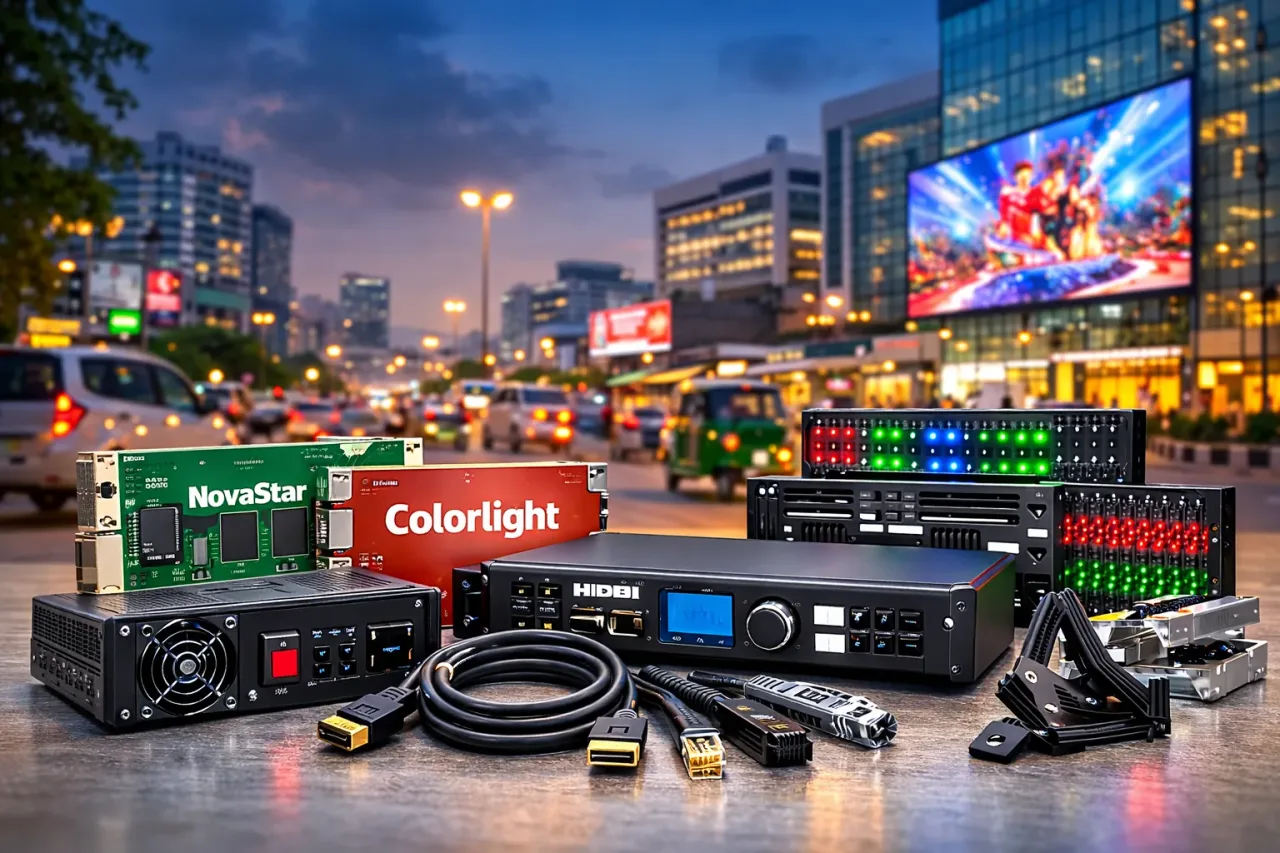
Quick Summary
- Define content update frequency before selecting platform.
- Select PSU class with load headroom for real operating profile.
- We run a pre-dispatch integration check: mapping behavior, signal recovery, thermal behavior, and content playback stability. This catches ecosystem conflicts before site pressure begins.
Introduction
How to build a reliable accessory stack across controller, receiving card, PSU, and module layers without integration surprises. The sections below explain the practical choices, trade-offs, and planning details to review before selecting a solution or requesting a quotation.
For available models and current planning details, visit our . For topic-specific options, see our .
Table of Contents
Section 1
Controller Layer: Pick by Workflow, Not Hype
Huidu, Colorlight, and Novastar can all perform well when aligned with project needs. The right choice depends on content complexity, remote control requirements, and future expansion plan.
A premium controller cannot compensate for poor integration discipline.
- Define content update frequency before selecting platform.
- Match controller capability to operator skill and support model.
- Validate sender-receiver and software version compatibility early.
Section 2
Power and Thermal Stability Rules
Power supply planning should be done with runtime and ambient temperature assumptions, not nameplate values only. Thermal stress and unstable input lines are frequent root causes in local deployments.
Spare strategy should be part of BOQ, not an afterthought.
- Select PSU class with load headroom for real operating profile.
- Avoid mixed-grade PSU batches in a single active zone.
- Keep replacement policy for PSU and receiving cards from day one.
Section 3
Compatibility Test Protocol Before Dispatch
We run a pre-dispatch integration check: mapping behavior, signal recovery, thermal behavior, and content playback stability. This catches ecosystem conflicts before site pressure begins.
Section 4
Our Delivery Framework: From Survey to Handover
Every project follows a fixed delivery framework so quality does not depend on luck: requirement discovery, site survey, technical recommendation, BOQ, electrical plan, structure review, installation, calibration, and handover.
This process reduces rework because decisions are validated before hardware reaches site.
- Pre-sales survey with viewing distance, daylight exposure, and content format checks.
- Controller-power-module compatibility check before procurement finalization.
- On-site quality checklist: grounding, mapping, thermal behavior, calibration.
- Handover package: wiring map, controller profile backup, and operator SOP.
Section 5
Bangladesh Deployment Realities We Plan For
Bangladesh projects need local context planning: high humidity, dust exposure, power fluctuation, monsoon rain, and heavy runtime during campaign periods.
We design maintenance and backup strategy early so the screen remains stable after launch.
- Division and district-level logistics coordination for installation windows.
- Power protection planning for unstable line conditions.
- Remote troubleshooting workflow for faster issue isolation.
Section 6
Accessory Stack We Commonly Standardize
Long-term uptime depends on stack quality, not only display module quality. Controller, receiving card, PSU, and signal chain must be matched as one system.
We align ecosystem choices with project complexity and operator capability.
- Controllers: Huidu, Colorlight, Novastar based on workflow depth and scaling plans.
- Power layer: G-energy class PSU and equivalent stable options where applicable.
- Module-accessory matching: Lampro and compatible professional-grade classes.